

The Child We Barely Knew
Reflections on 'Hamnet', parental loss, and enduring grief in body and mind

‘The joys of parents are secret, and so are their griefs and fears…’ Francis Bacon
In therapy, people sometimes say, “I don’t know why this is affecting me so much,” or “I thought I had already dealt with it.” Such responses are understandable, because our need to ‘carry on’ can push away the fear of what lies beneath the ice we are skating over.
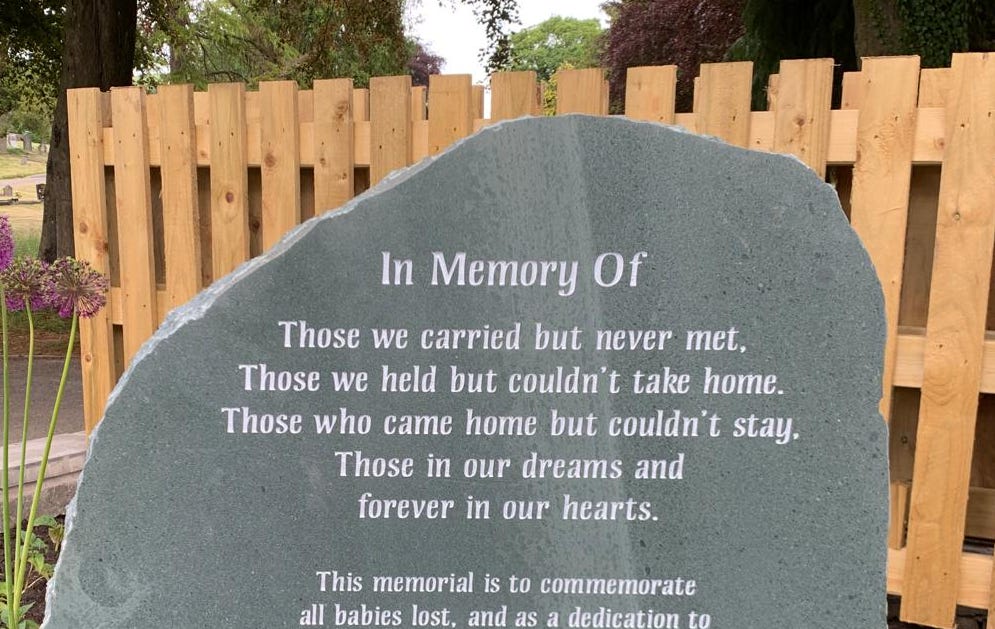
It’s so easy to underestimate grief and its profound impact. And such emotions are only intensified when they are associated with the death of a child, as conveyed in the following words I found inscribed on a slate in a memorial garden in Kendal, Cumbria.
Those we carried but never met.
Those we held but couldn’t take home.
Those who came home but couldn’t stay.
Those in our dreams
And forever in our hearts.
It is a memorial to all babies lost, and to parents who go on to suffer unspeakable grief — including those whose babies were taken from them through past government and church policies and forced into adoption. Many of those affected continue to suffer ongoing grief and trauma as a result of the wounds these separations create.
Sometimes we need art to carry the freight of our emotional experience. This is what the recently released film Hamnet, adapted from Maggie Farrell’s novel, so powerfully depicts: William Shakespeare and his wife, Anne Hathaway, locked into the sudden, agonising loss of their eleven-year-old son to the Black Death.
The two parents respond in very different ways: she becomes angry and numb; he holds his grief silently, withdrawing from her and directing his emotions into his passion for work. It’s a difference that opens up a chasm between them. What is boldly suggested in the film is that Shakespeare displaces his grief through creativity, expressing it in the momentous tragedy Hamlet.
When the play is performed at the Globe Theatre, Shakespeare himself becomes Hamlet’s ghost, suggesting that the parent who survives may be the one who no longer feels fully alive. This interpretation has the ring of truth. I have heard parents who have lost a child describe themselves as “transparent,” “thin,” “dead inside,” or only partially present in the life that follows.
There is a theory that the cruelty of Hamnet’s loss may also be echoed in Shakespeare’s sonnets:
“But out, alack! he was but one hour mine; The region cloud hath mask’d him from me now.” (Sonnet 33)
The body has barely learned the child before the world removes them, leaving time itself fractured. We need only hear the actress Jessie Buckley’s screams and paroxysmal cries expressing the pain of childbirth and child loss to know that what is being expressed is as elemental as life itself.
Grief is complex. It does not always look like tears; it can look like endurance. I once heard of someone living through agony with a child who had a chronic illness. Her best friend gave her a ring inscribed with the words “Keep going.” What better message of support? It points to the unseen burden carried by loved ones in the face of profound uncertainty while still needing, somehow, to function and continue on.
Grief is so hard to accept that it may be best to approach it indirectly. Emily Dickinson wrote of grief, “Tell all the truth but tell it slant,” pointing to the idea that the full force of truth is too overwhelming to grasp all at once, requiring a circuitous, unfolding approach for understanding and acceptance.
But death is in a different category. In the face of terrible finality, ‘going on’ can hardly seem possible. I have heard those who must keep going in the face of unspeakable difficulties, child grief, and uncertainty say that the only place they feel any relief is lying prostrate on the earth itself. They might say, “I can just about stand up, but I cannot move forward.” Yet move they must, to survive, to care for those who are left. This responsibility often renders daily life mechanical, lived with the quality of an automaton.
Many parents who lose children in cruel or wrongful ways find meaning in such a struggle. The mother of the teenager Harry Dunn, whose death due to careless driving made headlines in 2019, spoke of feeling her shoulders drop in relief when justice was finally done: an embodied descent after years of carrying grief. Michael Rosen, who lost his son to meningitis, similarly transformed loss into meaning through campaigning to raise awareness of the condition.
Some people grieve through movement, sensation, a relationship with the natural world; others through work, language, or action. There is no single way to grieve. We need to respect those who live with others lost in their dreams and in their hearts, and who find their own particular way to move through the dark woods.