

Love Will Find a Way
Every three minutes in the UK, someone is diagnosed with dementia. What can this dreadful illness teach us about trauma, memory and human worth?

Dementia is not itself a disease but a syndrome, caused by different conditions that damage the brain, Alzheimer’s disease being by far the most common cause. But because dementia affects the brain itself, it presents a challenge unlike almost any other illness. The changes arrive gradually, often unpredictably and never quite in a straight line. And because these changes are in the brain, they are largely hidden from plain sight.
Alzheimer’s disease is not simply a neurological illness. It is also a profound trauma, for the person diagnosed and for everyone who loves them.
Unlike a sudden bereavement, dementia unfolds slowly, requiring families to adapt again and again to losses that never quite finish. Losing oneself, or a loved one, is a slow, ongoing journey into the unknown.
When the celebrated novelist and philosopher Dame Iris Murdoch was diagnosed with Alzheimer’s in 1995, she described the experience with heartbreaking clarity: “At the moment I’m just falling, falling... just falling as it were. I think of things and then they go away forever.” For someone whose life revolved around language, imagination and thought, to realise that her own mind was changing and drifting away from her grasp must surely have been almost unbearable to contemplate.
Yet Alzheimer’s is never experienced by one person alone. Those closest to someone with dementia often describe living through “the long goodbye”. They watch someone they love change while trying to reconcile the person standing in front of them with the one they have always known. The grief begins long before death.
Lisa Ridzén captures this beautifully in her novel When the Cranes Fly South. When Bo visits his wife Fredrika in a care home, he says with a moving finality: “Then I meet your eye and feel sad, because there is none of you left in there.”
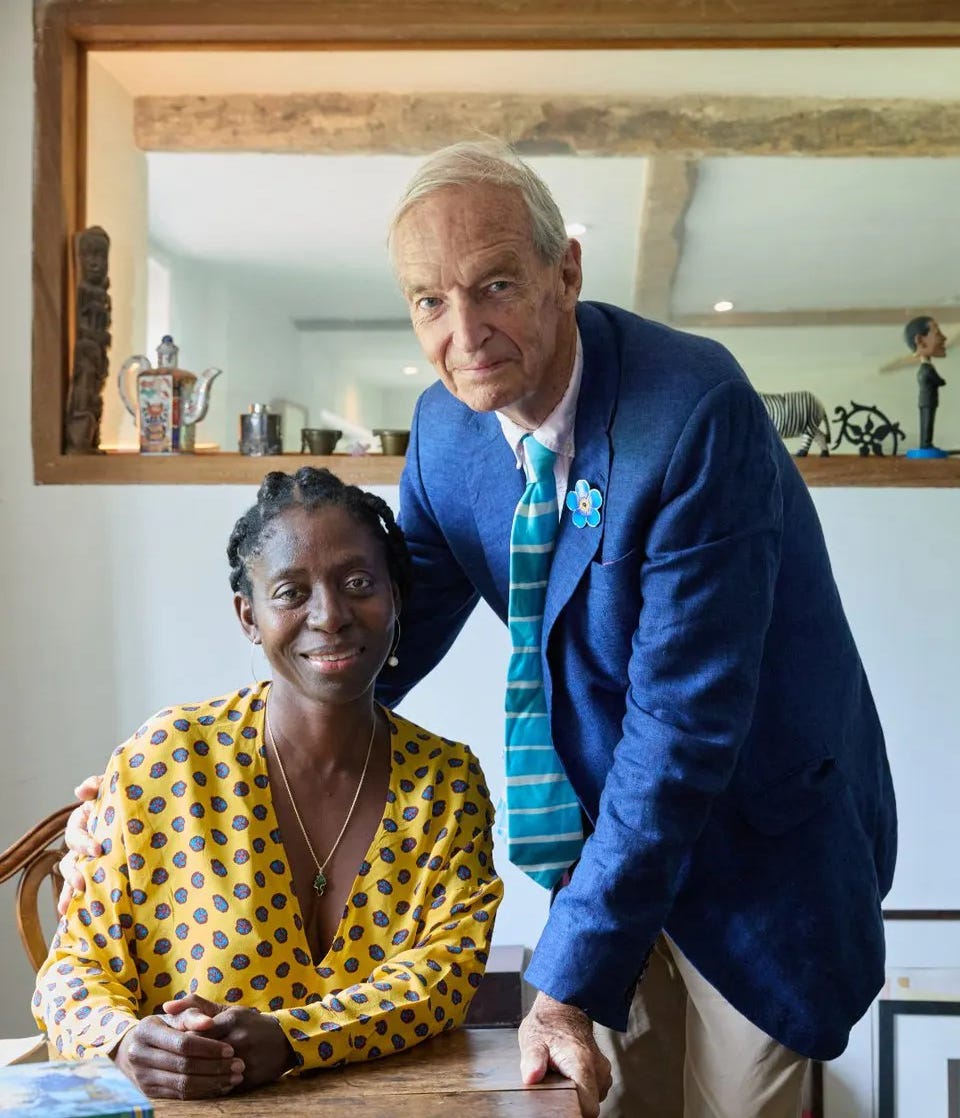
Many readers in the UK will have become more aware of dementia because of the recent diagnosis of veteran journalist and news anchor Jon Snow. Our society often writes people off once they receive a diagnosis of Alzheimer’s disease. “It’s like you’re dead,” recalls Jon, on being made aware of the painful truth.
Yet his wife believes the worst thing for him would be to disappear behind closed doors. Precious Lunga is herself a neuroscientist. She understands how brains work, how stress changes them and how Alzheimer’s gradually damages areas such as the hippocampus, which plays a vital role in forming memories.
She also understands something equally important: that even when memory changes, the person does not simply disappear.
That truth must be actively defended. Trauma often shrinks a person’s world. Precious gently resists that shrinkage. Rather than allowing Jon’s diagnosis to define him, she continues helping him inhabit the person he has always been.
Doing what he has always done matters. So, they revisit places that matter to them. They travel. They laugh. They continue creating memories, even if some of those memories may not last. Precious understands that creativity helps mitigate anxiety and strengthens resilience. A powerful example of this comes when Jon returns to a subject that has informed his journalism for six decades: investigating injustice.
Reporting is not simply something Jon did. It is part of who he is.
The documentary, Jon Snow: A Last Big Story, follows him as he travels to Zambia to expose the devastating pollution that has poisoned the land and water of local communities.
His brain has changed. Yet so much of the journalist who spent six decades exposing injustice remains intact. The documentary weaves archive footage through the present-day story, reminding us not only what Jon did but who he has always been.
Standing amid the devastation of 9/11, his instinctive empathy is immediate; challenging Israeli officials to “just talk to Hamas” reminds us of his willingness to ask difficult questions; and reporting from Bhopal, his outrage on behalf of those who suffer is as strong as ever. Yet these are not simply archive clips. They reveal qualities that Alzheimer’s has not erased: compassion, moral clarity, intellectual courage and an instinct to bear witness. His capacity for incisive thought has not disappeared simply because memory has become more fragile. That is perhaps the documentary’s greatest lesson.
Snow’s humour remains magnificent throughout. Recalling his first days as a TV broadcaster, he jokes that he felt he was “the most colourless thing in the newsroom” until a friend who made ties began supplying him with the endless collection of primary-coloured neckwear that became his trademark on Channel 4 News. “I didn’t just wear them,” he laughs. “I rode them!”
One particularly revealing moment comes when Jon meets his former Channel 4 colleague Ben de Pear. Ben admits he felt anxious beforehand, wondering how much Jon might have changed. Yet within minutes they are laughing together in the back of a taxi exactly as old friends do. Jon’s warmth, humour and curiosity remain. Ben visibly relaxes because he realises the essence of his friend is still there.
Dementia is a journey neither the person diagnosed nor those who love them would ever choose. Watching Jon Snow and his remarkable wife Precious gave me a glimpse of what it can look like to live with Alzheimer's openly and creatively, refusing to let the disease dictate the whole story. In doing so, they challenge many of the assumptions that surround the disease.
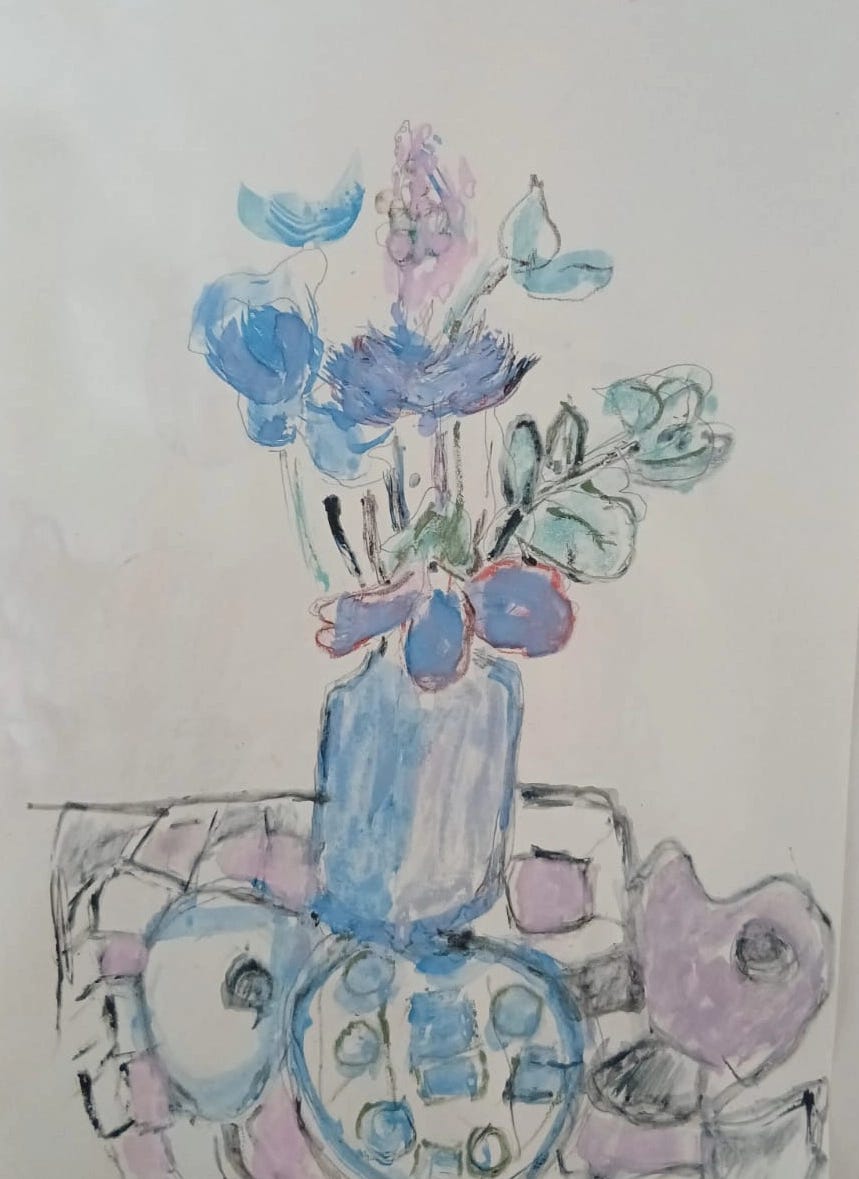
Creativity and purpose do not cure Alzheimer's. But they can help people continue to express who they are.
My friend’s mum Jean is currently further down the road of dementia than Jon. She hardly recognises her own daughters. The fullness of herself is barely apparent much of the time. But she recently painted this flower picture (above). It reveals the exquisite sensitivity that has always been a hallmark of her personality.
People living with Alzheimer’s should never be reduced to their diagnosis. I think of my much-loved neighbour Mike, an artist who now lives in a local care home. On the wall of his room hangs a simple board headed:
“Things Mike Likes”
Jazz. His favourite foods. The things that have always made him smile. He may not always be able to tell you these things himself, but they remain part of him. They belong to his story.
His song still deserves to be sung.
The psychiatrist Viktor Frankl argued that while we cannot always control what happens to us, we retain the freedom to choose our response. That truth does not erase suffering. But it can preserve dignity, even with Alzheimer’s.
The lengths we go to to do this are sometimes staggeringly beautiful. Perhaps that is why, when Mike’s care home organised a birthday celebration with his daughter, on his balcony, complete with cake and bunting, he smiled his old smile and said: “I’m in seventh heaven.”
Alzheimer’s may change memory. It may alter language, confidence and independence. But it does not erase the need for joy, nor the capacity to love or to be loved.
A person living with Alzheimer’s is still worthy of joy, still worthy of love.
When I think of Jon;
When I think of Mike;
When I think of Jean;
When I think of every family living through the long goodbye, I know that love finds ways of reaching places that memory sometimes cannot.
In the final chapter of my book 20 Ways to Break Free from Trauma, I explore post-traumatic growth: the possibility that even on life’s bleakest paths something life-giving can still be found. You can order your copy here:
What a beautiful and thoughtful article, Philippa. I found it very insightful , and will remember what you wrote when meeting people with dementia.
Thankyou x
This made me well up. My mum is on the cusp of being diagnosed with dementia. 13 years after her father, my grandad, died with it. A lovely reminder of the importance of being kind and humane throughout what is to come. Thank you