

Finding Your Feet
Japanese culture has much to teach us about doing the right thing with an often overlooked part of the body

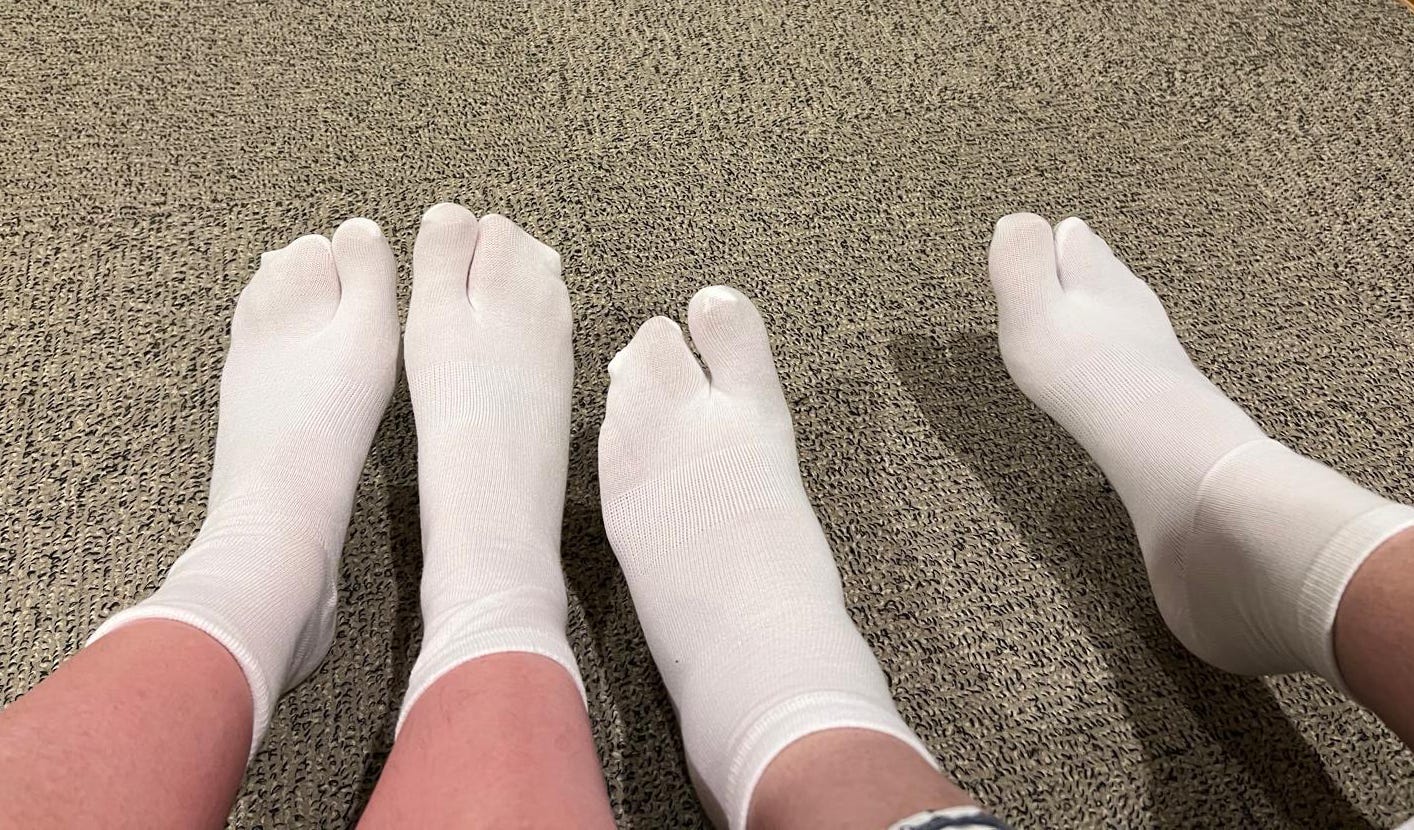
Japan is full of foot rituals. For example, there are traditional socks to be worn with light indoor shoes, or uwabaki. You remove your outdoor shoes at the threshold of a house, then turn them to face outwards, ready for the right direction of travel. There are even separate shoes to be worn only in toilets.
Why all this attention on feet? For the Japanese, removing shoes before entering a home invites a touch of mindfulness. As you step out of your outdoor shoes, you pause at the threshold between the outer world and your inner sanctuary. You prepare yourself differently. You reconnect with your body, your environment and your home.
I love this mindful attention embedded in Japanese culture, and it got me thinking. What happens when we consider our feet not as functional appendages attached to our legs that we pound along on and mostly ignore, but as brave and hard-working points of contact with the ground? After all, our feet carry us from place to place, and work for us. Their thousands of dense nerve endings give our brains instant feedback about balance, posture and terrain, and help protect us from injury.
Of course, it’s not only in Japan. Think about how language is peppered with feet allusions. We talk about people being ‘grounded’. Or we say that they cannot ‘get their feet on the ground’. Reflexology uses a specific ‘foot map’ to locate zones connected with other parts of the body; by using targeted pressure, this practice aims to stimulate healing and relaxation. Maybe this is why having our feet gently touched can feel so good.
How often do you notice your feet? Perhaps, as you read this now, you might pause for a moment to do just that. Are they warm or cold? Tense or relaxed? Pressed firmly into the floor or hovering lightly above it?
In my trauma work I often invite people to imagine themselves as trees, their feet rooted deeply in the earth beneath them, drawing up nourishment and stability from below.
Trees do not apologise for being connected to the ground, and perhaps we should not either.
Trauma, the feeling of being overwhelmed, often pulls our attention upwards into vigilance, thinking and survival. But to mitigate trauma, we can draw ourselves gently back downwards into sensation, into gravity, into the body itself; to find our place in the world and land.
I recently read How to Survive Losing It All by Lindsay Nicholson, where she shares some of her discoveries in life after facing numerous devastating losses. Lindsay loses her husband, her daughter, survives cancer and a car crash, and eventually loses the senior editorial role she had held for decades at Good Housekeeping. That final loss precipitates a re-examination of her life.
She travels to a Californian ranch where horses are used therapeutically, gingerly leading her horse around the paddock. The instructor, J-Vo, says:
“You’re never safe unless you’re in your own body.” Then she asks:
“Can you feel your feet?”
Lindsay describes forcing her attention downwards towards the sand and soil beneath her. She becomes aware of tension in her jaw and legs. She flexes her toes and drops her weight through the soles of her feet, consciously feeling the ground beneath her.
She writes that her “abdomen snaps to attention” and she feels “balanced, solid and secure, relaxed yet alert.”
With the descent, she relaxes. Then, the horse, sensing her slower heartbeat from four feet away, gently comes to stand beside her, breathing into her neck. Her nervous system has communicated with the animal. It feels like a breakthrough.
Lindsay shares how rarely she has felt safely inside her own body. Instead, much of her life had been organised around work, achievement, competence and intellectualising.
In my experience as a psychotherapist, overworking is a common coping strategy. It creates a relentless treadmill of doing and achieving that distracts us from the deeper feelings living underneath. These coping strategies often begin as forms of protection and survival. They help us move away from fear, helplessness or vulnerability held in the body. But over time they become habitual. Our minds and nervous systems travel the same tramlines repeatedly until we can lose awareness of what is happening inside us altogether.
Sometimes clients describe this disconnection very vividly.
“I feel like a head on a stick,” one person once told me.
What an honest description of how many humans live.
But a simple invitation to feel our feet can immediately interrupt this pattern. It gently redirects attention downwards, away from spiralling thoughts and back towards physical presence.
I know this from my own life. When I first entered counselling as a young woman and properly turned my attention inward, I noticed with surprise how tightly I clenched my stomach. My abdomen rarely softened enough to fully breathe out.
Years later, a chiropractor and osteopath touched my feet carefully and simply said: “Complicated.” I never entirely knew what he meant, but I suspect he felt the tension I carried there. I’m someone who adores a foot massage. My feet always seem to need attention. When I consciously soften them, I immediately feel more grounded, more present. I’m reminding myself that I am safe in this moment.
It’s surprising how many of us move through life without ever feeling completely safe inside our bodies. What can help is when we consciously allow ourselves to feel supported from underneath.
Can we feel the love all the way to our feet?
One of my favourite stories in 20 Ways to Break Free from Trauma is about a girl named Daniela.
“Daniela is consistently abused within and outside her birth family and is not cared for or properly protected. She becomes a street fighter. She chronically neglects her body, which often feels numb and cold. As others have violated her, she sometimes hurts herself simply to feel something in her frozen body.
Eventually Daniela finds a stable foster family. Her hands and feet are always cold and yet she often forgets to put gloves and socks on. She is amazed when her foster family notice her red hands and feet and gently encourage her to cover them.
She notices that when her feet are warm, her breathing flows more smoothly and she feels a little safer.
After some time, one of her foster sisters buys her a foot spa wrapped in blue tissue paper. Daniela unwraps it carefully, noticing the softness of the paper against her fingers. Later, alone, she heats the foot spa and watches the steam rise from the water. Tentatively she dips in one cold toe, then another, into the delicious warmth.
It is a revelation: not simply the warmth itself, but the astonishing experience of somebody noticing her needs. That somebody cares about her feet, about her comfort, about her body. Suddenly she wells up, weeping hot bitter tears.
As her feet are warmed, her senses awaken and her spirits lift in response to the care contained within the gift.
Healing sometimes begins in very small moments like this. Not through dramatic insight, but through tiny bodily experiences of comfort, grounding and safety. They need to be tiny. We might tense all over again if too much comes too soon.
Our feet quietly tell stories about us
Many people treat their feet with disdain or embarrassment. Lindsay Nicholson describes powerful women squeezing themselves into fashionable stilettos as “foot binding for a modern era.”
In How to Survive Losing it All, J-Vo says something else that stayed with me.
“If you want to know what someone is really thinking, don’t look into their eyes. Look at their feet. If they truly want to be with you, their feet will point towards you. If they are planning to leave, their feet will point towards the door.”
I am going to watch people’s feet more closely in future.
An exercise for you to try at home
So maybe, before rushing onto the next thing today, you might pause for a moment.
Notice your feet.
Wiggle your toes slightly.
Feel the contact between your soles and the ground beneath you.
Notice whether you are holding tension in your stomach or jaw.
Let your weight drop just a little lower.
Allow gravity to support you.
Here is a simple exercise adapted from the first chapter of my book:
Rest your whole body on the ground, with your legs stretched out. If it feels more comfortable, bend your knees with the soles of your feet touching the floor. Find the right position for you.
Take a little time to properly arrive inside your body.
Imagine your body making an imprint in warm sand. What would the shape look like? Would one side feel heavier than the other?
As you imagine this, allow the weight of your body to sink a little lower, feeling yourself supported from underneath.
Gently roll your head from side to side, pausing softly in the middle each time. Feel the weight of your head and notice the muscles working.
Let your knees fall slowly a little from side to side. Feel the weight of your pelvis and allow the ground to gently support you.
Then simply pause.
Feel your feet.
Feel gravity underneath you.
Feel that, in this moment, you are being held.
And now, to finish with, a tiny poem:
Surrender to Gravity
Gravity is my best friend
Always present
Always available
Always ready to respond
Gravity is holding me
Letting me sink
Absorbing all my stress
Downwards
Have you tried exercises like this before? What has been your experience of paying attention to your feet? Have you come across other cultures that emphasise care of the feet? Feel free to leave your comments below!